
Rebar Options & Grades UK: B500B Sizes T8–T40 Guide
Last updated:
Compare UK rebar grades, sizes T8 to T40, ductility classes B500B vs B500C, carbon vs stainless steel, weight-per-metre data, and cut-and-bent service to BS 8666.
| Size | Diameter (mm) | Area (mm²) | Weight (kg/m) | 6m Bar Weight (kg) | Typical Use |
|---|---|---|---|---|---|
| T8 | 8 | 50.3 | 0.395 | 2.37 | Links and stirrups in beams and columns |
| T10 | 10 | 78.5 | 0.617 | 3.70 | Slab distribution bars, light foundations |
| T12 | 12 | 113 | 0.888 | 5.33 | Domestic slabs, wall starters, garage foundations |
| T16 | 16 | 201 | 1.58 | 9.48 | Strip foundations, ground beams, retaining walls |
| T20 | 20 | 314 | 2.47 | 14.82 | Pad foundations, large retaining walls |
| T25 | 25 | 491 | 3.85 | 23.10 | Pile caps, transfer beams, heavy foundations |
| T32 | 32 | 804 | 6.31 | 37.86 | Deep beams, commercial columns |
| T40 | 40 | 1257 | 9.86 | 59.16 | Heavy civil engineering, bridge piers |
| Property | B500A (Class A) | B500B (Class B) | B500C (Class C) |
|---|---|---|---|
| Yield strength (Re) | 500 MPa | 500 MPa | 500 MPa |
| Min. elongation at max force (Agt) | , | 5.0% | 7.5% |
| Tensile/yield ratio (Rm/Re) | , | ≥ 1.08 | 1.15–1.35 |
| Ductility class | Class A (low) | Class B (normal) | Class C (high) |
| Weldable | Yes | Yes | Yes |
| UK availability | Rare, mostly wire/mesh | Standard stock grade | Special order |
| Typical use | Mesh fabric to BS 4483 | General construction | Seismic or >20% moment redistribution |
| NDS stock | No | Yes, T8 to T40 | No, contact for availability |
| Property | Carbon Steel (B500B) | Stainless Steel (BS 6744) | Epoxy-Coated |
|---|---|---|---|
| Standard | BS 4449:2005+A3:2016 | BS 6744:2016 | BS 7295 (withdrawn) |
| Yield strength | 500 MPa | 500 MPa (grade 500) | 500 MPa (base bar) |
| Cost multiplier | 1x (baseline) | 5–8x carbon price | 1.5–2x carbon price |
| Corrosion resistance | Low, relies on concrete cover | High, resists chlorides | Moderate, coating must stay intact |
| Design life (typical) | 50–60 years with adequate cover | 100+ years in aggressive exposure | 50–80 years if coating undamaged |
| Surface profile | Ribbed (mechanical bond) | Ribbed (mechanical bond) | Ribbed with epoxy layer |
| Weldability | Weldable to BS EN ISO 17660 | Requires specialist procedure | Cannot weld, damages coating |
| UK availability | Immediate, all sizes stocked | 2–4 week lead time | Limited, declining UK use |
| Best for | General construction | Marine, coastal, de-icing salt exposure | Bridge decks (historical) |
What Rebar Sizes Are Available in the UK?
Standard UK rebar runs from 8mm to 40mm nominal diameter in eight sizes: T8, T10, T12, T16, T20, T25, T32, and T40. We stock all eight in B500B grade, supplied in 6m straight lengths. T10, T12, and T16 account for the majority of domestic orders, foundations, slabs, and retaining walls rarely need anything heavier.
Each size has a fixed cross-sectional area and weight per metre. T12 gives you 113 mm² at 0.888 kg/m. T16 gives you 201 mm² at 1.58 kg/m, almost double the steel area. T25 at 491 mm² and 3.85 kg/m is the crossover point where manual handling gets heavy; a 6m bar weighs 23.10 kg. T32 and T40 are used on commercial and civil projects where design loads demand concentrated reinforcement.
Check the rebar sizes table above for the full breakdown. For mesh reinforcement as an alternative on flat slabs, see our mesh types comparison guide.
What Is B500B Grade and Why Does It Matter?
B500B means the bar has a characteristic yield strength of 500 MPa and normal ductility (Class B) to BS 4449:2005+A3:2016. The "B500" is the strength, 500 N/mm². The trailing "B" is the ductility class. It replaced the old grade 460 system and is now the standard stock grade across the UK.
Mechanical requirements for B500B include a minimum elongation at maximum force (Agt) of 5.0% and a tensile-to-yield ratio (Rm/Re) of at least 1.08. These numbers matter because they define how much the bar can stretch before breaking. Your structural engineer uses them to calculate safe bending and lap lengths.
If a drawing says B500C, you cannot substitute B500B. B500C requires 7.5% minimum elongation and an Rm/Re ratio between 1.15 and 1.35. The ductility comparison table above shows every difference. We supply B500B in all sizes from T8 to T40.
When Would You Use Stainless Steel Rebar Instead of Carbon?
Stainless steel rebar to BS 6744:2016 is specified where chloride attack would corrode carbon steel faster than the design life allows. That means coastal structures, sea walls, bridge decks exposed to de-icing salts, car park decks, and tunnels. The stainless grade resists pitting corrosion even when concrete cover cracks or carbonates over time.
The trade-off is cost. Stainless rebar runs 5–8x the price of equivalent carbon steel B500B. A 12mm carbon bar might cost under £7, while the stainless equivalent exceeds £35. Life-cycle analysis often justifies this for structures designed to last 100+ years in aggressive exposure classes XD3, XS2, or XS3 (as classified in BS EN 206 and BS 8500).
For most UK domestic and light commercial work, carbon steel B500B with adequate cover to BS 8500 is the correct and cost-effective choice. Stainless is a specialist product, your engineer will specify it when needed.
How Does Cut-and-Bent Rebar Work?
Cut-and-bent rebar arrives on site pre-shaped to your bar bending schedule, tagged by bar mark and ready to fix. The process follows BS 8666:2020, which defines over 30 standard shape codes. Common shape codes include:
- Shape Code 11: 90-degree L-bar for starter bars
- Shape Code 21: U-bar for slab edges and beam stirrups
- Shape Code 38: helical links for circular columns
You send us your bending schedule or engineering drawing. We cut each bar to length, bend it to the specified shape code and dimensions, then bundle and label by bar mark number. On site, your steel fixer matches labels to the schedule and ties bars in position without any cutting or bending.
Pre-bent bars reduce site waste to near zero and cut fixing time by up to 40% compared to bending from straight stock. Every bar is B500B grade, CARES approved, and fully traceable to its mill certificate.
What Is the Difference Between Ribbed and Plain Rebar?
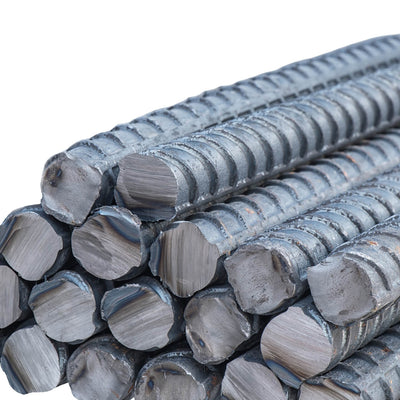
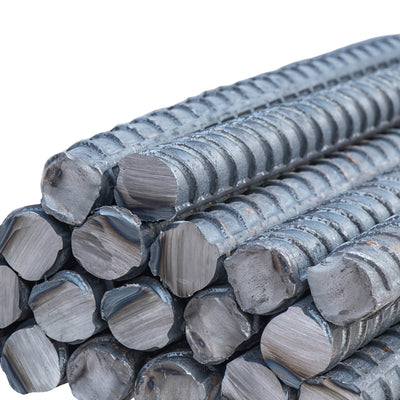
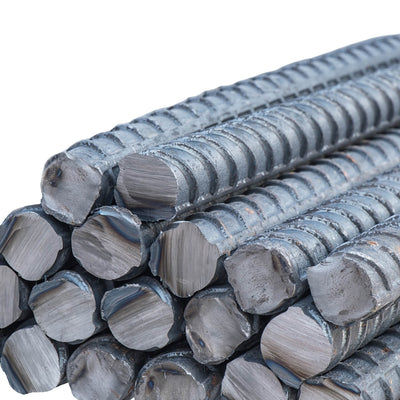
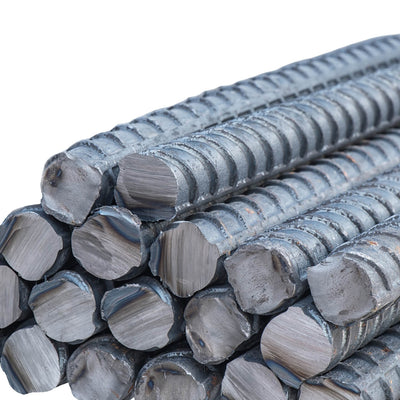
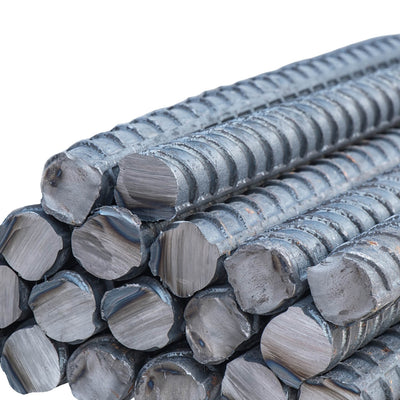
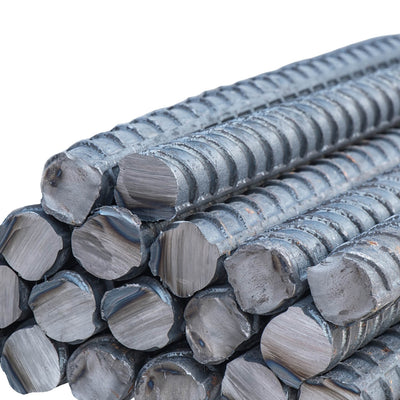
Ribbed rebar has a pattern of raised lugs rolled into its surface during manufacture. These ribs create mechanical interlock with the surrounding concrete, providing bond strength far superior to plain round bar. All B500B rebar to BS 4449 is ribbed; this is the default for any reinforcement carrying structural loads in the UK.
Plain round bar (R-bar) has a smooth surface and is specified only in limited situations: links in lightly loaded beams, distribution bars in some older designs, and specific detailing where the engineer requires free movement between bar and concrete. Plain bar is typically grade 250 (250 MPa yield), not 500 MPa.
In modern UK practice, over 95% of reinforcement is ribbed B500B. If your drawing shows "T" prefix (e.g., T12, T16), that denotes high-yield ribbed bar. An "R" prefix (e.g., R8, R10) denotes plain mild steel bar. Always match the prefix on your bending schedule.
Does Rebar Need UKCA Marking and Mill Certificates?
Structural reinforcement placed on the GB market requires appropriate conformity assessment under the UK Construction Products Regulations. In practice, this means your rebar should carry UKCA marking (or CE marking during the transition period) and come with a Declaration of Performance tracing back to the manufacturing mill.
Mill test certificates confirm that each batch meets BS 4449 mechanical properties: 500 MPa yield strength, the required elongation for its ductility class, and chemical composition limits for weldability. CARES certification sits on top of this, providing independent third-party verification of both the manufacturer and the supply chain.
Building control and main contractors routinely request these documents before allowing steel to be fixed. If your supplier cannot provide mill certificates and CARES documentation, you risk rejection at inspection. All rebar from NextDaySteel is CARES approved with full traceability from cast number to site delivery.
How to Calculate Rebar Weight per Metre
Mass (kg/m) = diameter (mm)² × 0.00617How to Calculate Total Bar Weight for a Given Length
Total weight (kg) = length (m) × mass per metre (kg/m)Frequently Asked Questions
Is UK rebar grade 460 or 500?
Grade 500. The old 460 MPa system was replaced when BS 4449 adopted the B500 designation.
What is the weight per metre of 12mm rebar?
T12 rebar weighs 0.888 kg per metre. A standard 6m bar weighs 5.33 kg. You can calculate any rebar weight using the formula: mass (kg/m) = diameter (mm) squared times 0.00617. For T12 that is 12 x 12 x 0.00617 = 0.888 kg/m.
What is the difference between B500B and B500C rebar?
Both share 500 MPa yield strength, but B500C has higher ductility. B500B requires minimum 5.0% elongation at maximum force and an Rm/Re ratio of at least 1.08. B500C requires 7.5% minimum elongation and an Rm/Re ratio between 1.15 and 1.35. See the relevant table above for details.
Can you weld rebar in the UK?
Yes, B500B rebar is weldable to BS EN ISO 17660. The standard requires controlled carbon equivalent values to prevent brittle welds. Welding must be carried out by certified operatives under the appropriate welding procedure specification.
What rebar size do I need for a foundation?
It depends on the foundation type and your engineer's design. Domestic strip foundations typically use T12 or T16 longitudinal bars with T8 or T10 links. Pad foundations for heavier point loads often use T16 or T20 in both directions. See the relevant table above for details.
What British Standard applies to rebar in the UK?
BS 4449:2005+A3:2016 is the current standard for carbon steel rebar, covering bar, coil, and decoiled product. It defines B500A, B500B, and B500C ductility grades, all at 500 MPa yield strength. Stainless steel rebar falls under BS 6744:2016. Cutting and bending follows BS 8666:2020.
What does the T mean in T12 rebar?
The "T" prefix stands for high-yield deformed (ribbed) bar. T12 means a 12mm diameter ribbed bar at 500 MPa yield strength. An "R" prefix denotes plain (smooth) mild steel bar at 250 MPa, used only for links in certain older designs.
Customer Reviews
4.8/5 from 203 Google reviews"Excellent service as always , great prices, fast delivery. What more does a customer want!? Very happy to recommend Next Day Steel"
"Good team, on time, easy communication, will recommend."
"Next day steel were recommended to me and I'd definitely use them again. Fabien was really helpful and responsive whilst making sure everything was delivered on time."